9 professions and skills in plastic injection molding: the experts behind every industrial part
Plastic injection molding is one of the most widely used manufacturing processes in industry today. From watchmaking components to medical devices, automotive parts and electronics, it enables complex parts to be produced with great precision and on a large scale.
However, behind every injected part lies a chain of specialized trades. From design to final delivery, many professionals are involved to guarantee product quality, reliability and performance.
The product designer: at the origin of the project
Every project starts with an idea or an industrial need. The product designer defines the functional characteristics of the part:
- Dimensions
- Mechanical resistance
- Aesthetics
- Constraints on use
- Cost targets
Its role is to transform a requirement into an industrially feasible part.
The CAD draftsman: transforming the idea into a 3D model
Once the specifications have been established, the CAD draftsman creates a 3D model of the part.
This stage is essential, because a part intended for plastic injection molding must comply with certain technical rules:
- Homogeneous thicknesses
- Skinning angles
- Reducing shrinkage
- Optimization of reinforcing ribs
These choices have a direct impact on final quality and production costs.
The mold designer: a high-precision job
The mold is often the most important investment in a plastic injection molding project.
The mold designer develops tooling capable of producing thousands or even millions of identical parts, while guaranteeing consistent quality.
In particular, it must define :
- Fingerprints
- Ejection systems
- Cooling circuits
- Injection points
Every detail has an impact on production performance.
Machinists: making tooling
Mould components are then produced by specialist machinists.
Using CNC machining centers, electro-erosion or precision grinding, they manufacture the various parts that will make up the mold.
Their work requires extremely low tolerances to guarantee the precision of the tooling.
Fitters: assembling the mold
Once the components have been manufactured, the fitter assembles the mold.
He checks that the mechanisms are working properly and makes any necessary adjustments to ensure reliable, long-lasting production.
The injection technician: the settings specialist
The injection technician plays a central role in manufacturing.
It sets the press parameters:
- Temperature
- Pressure
- Injection speed
- Hold time
- Cooling time
Our expertise enables us to optimize part quality while reducing scrap and cycle times.
Production operators
Operators monitor production runs on a daily basis.
They monitor equipment, carry out visual checks and intervene rapidly in the event of any anomaly.
Their vigilance contributes directly to the quality of finished products.
Quality controllers
All parts must be checked before shipping.
Quality controllers carry out a variety of checks:
- Dimensional control
- Visual inspection
- Functional control
- Validation of customer specifications
This step ensures that each part meets the requirements defined during project development.
Logistics and packaging: protecting parts until they reach their destination
The quality of a part depends not only on its manufacture. Storage, handling and transport also play a vital role.
Injected parts can be sensitive to :
- With stripes
- To the dust
- To shocks
- To deformations
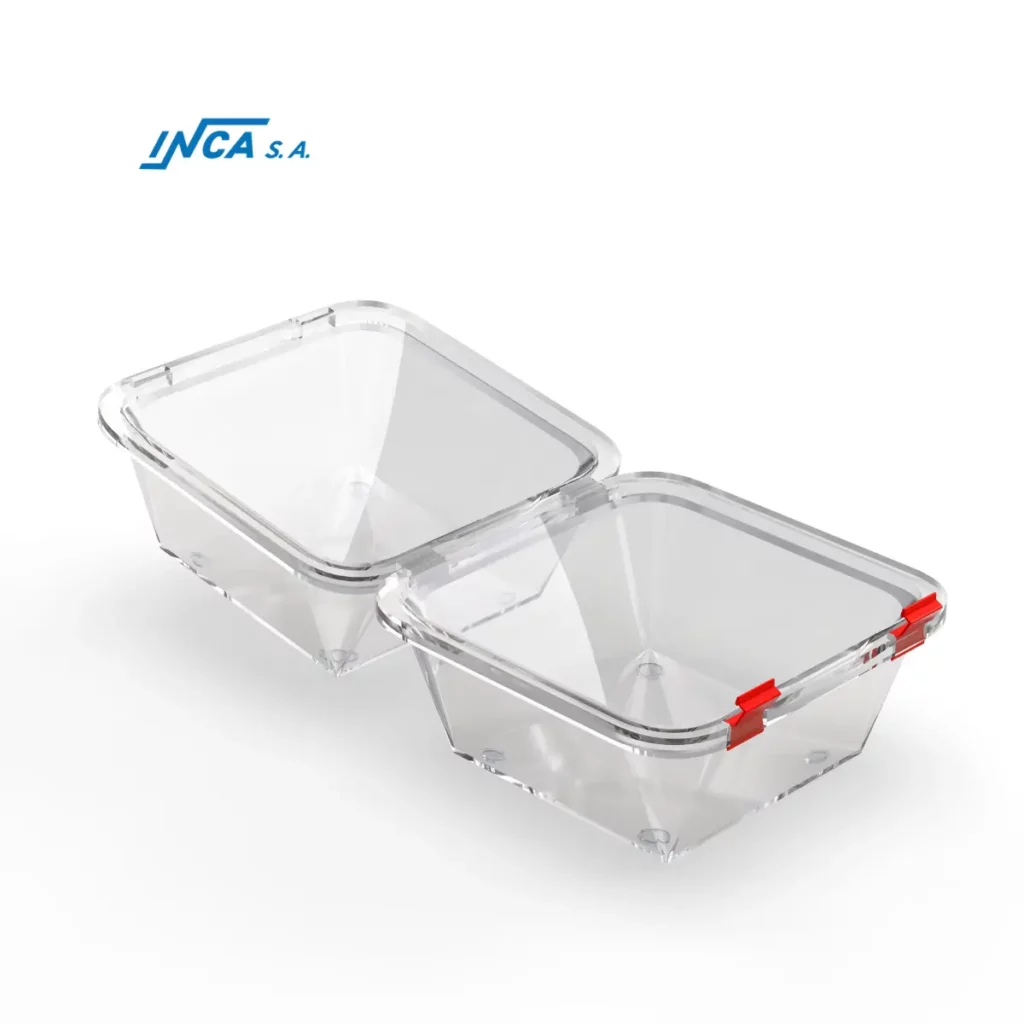
This is why technical packaging solutions play such an important role in the industrial chain.
An industry driven by human skills
Injection molding is often associated with machines and automation.
Yet at INCA SA, we know that the success of plastic injection molding depends above all on the expertise of the men and women involved at every stage of the process.
Designers, technicians, machinists, quality controllers and packaging specialists all contribute to the manufacture of reliable, precise, high-performance products.
Behind each injected part lies a veritable chain of industrial know-how.